Instructions are code
The rules, the limits and the prompt of each agent are in versioned source files, not in free text.
 Quantum-Safe Ingestion
Banking, insurance and public sector organisations hold decades of records in EBCDIC, packed decimals and COBOL layouts. RSA and elliptic curve encryption will not withstand a capable quantum computer. Quantum-Safe Ingestion reads that data read-only, seals each record at the point of entry, and proves each step in a signed audit chain. The source system does not change.
One record
Select a stage. The record below is an illustration with sample values, and the bytes are correct EBCDIC and packed decimal.
C1 C3 C3 E3 F0 F0 F4 F1 F7 01 23 45 0C
The tool opens the file read-only. Nine bytes of EBCDIC text, then four bytes of packed decimal. A text editor shows these bytes as noise.
ACCOUNT-ID   PIC X(9)             ACCT00417
BALANCE      PIC S9(5)V99 COMP-3  +1,234.50
Deterministic rules read the COBOL copybook and give each byte a meaning. No AI model reads the file. The reader uses the layout only after an authorised person signs it.
nonce       00 00 00 00 00 00 00 00 00 00 00 2A
ciphertext  9E 41 7B D0 55 1C A8 3F 62 E7 0B 94 C6 ...
tag         5D 8A 13 F2 7C 09 E6 4B A1 3E 90 D7 26 B8 4F 61
AES-256-GCM seals the record at the point of entry. The 16-byte tag also covers the source and the origin of the record, so a record cannot move to a different place without detection.
previous    7F 20 C4 9A ... B3 18
this event  HMAC-SHA-512(previous, event)
head        E2 5B 06 D1 ... 4C A7
Each event goes into an audit chain. Each link holds the hash of the link before it. A change to one entry, one bit of one record, or the order of the events breaks the chain, and the tool shows the exact place.
checkpoint  head E2 5B 06 D1 ... 4C A7, 37 events
signature   ML-DSA-87, 4,627 bytes
verify      one public key, no secret, no tool
ML-DSA-87 signs the head of the chain. A third party verifies the signature with one public key. The evidence package holds all that the third party needs.
The process
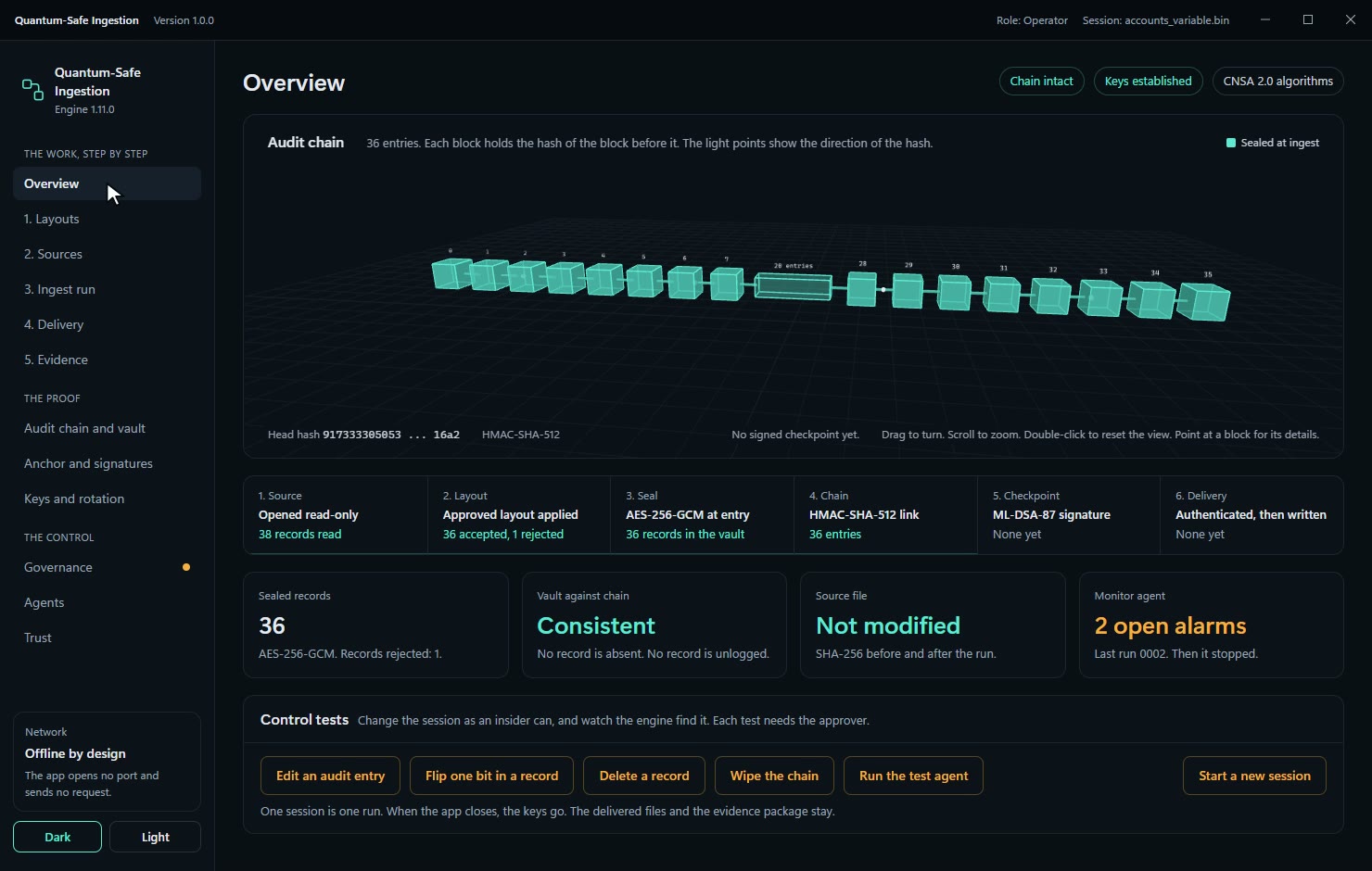
Read-only access to the legacy data. Nothing is written to the source system or installed on it.
Deterministic rules turn the COBOL copybook into a layout. No AI model reads the file.
An authorised person approves each layout with a reason and a passphrase before the reader uses it.
AES-256-GCM seals each record at the point of entry. A record that fails a rule is rejected, with its reason.
An HMAC-SHA-512 audit chain links each event to the event before it.
ML-DSA-87 signs the head of the chain. ML-KEM-1024 establishes the keys.
JSON Lines, CSV or Parquet, with a signed manifest and control totals. The tool authenticates each record before it writes it.
One evidence package. A third party verifies it with one public key and without the tool.
Cryptography
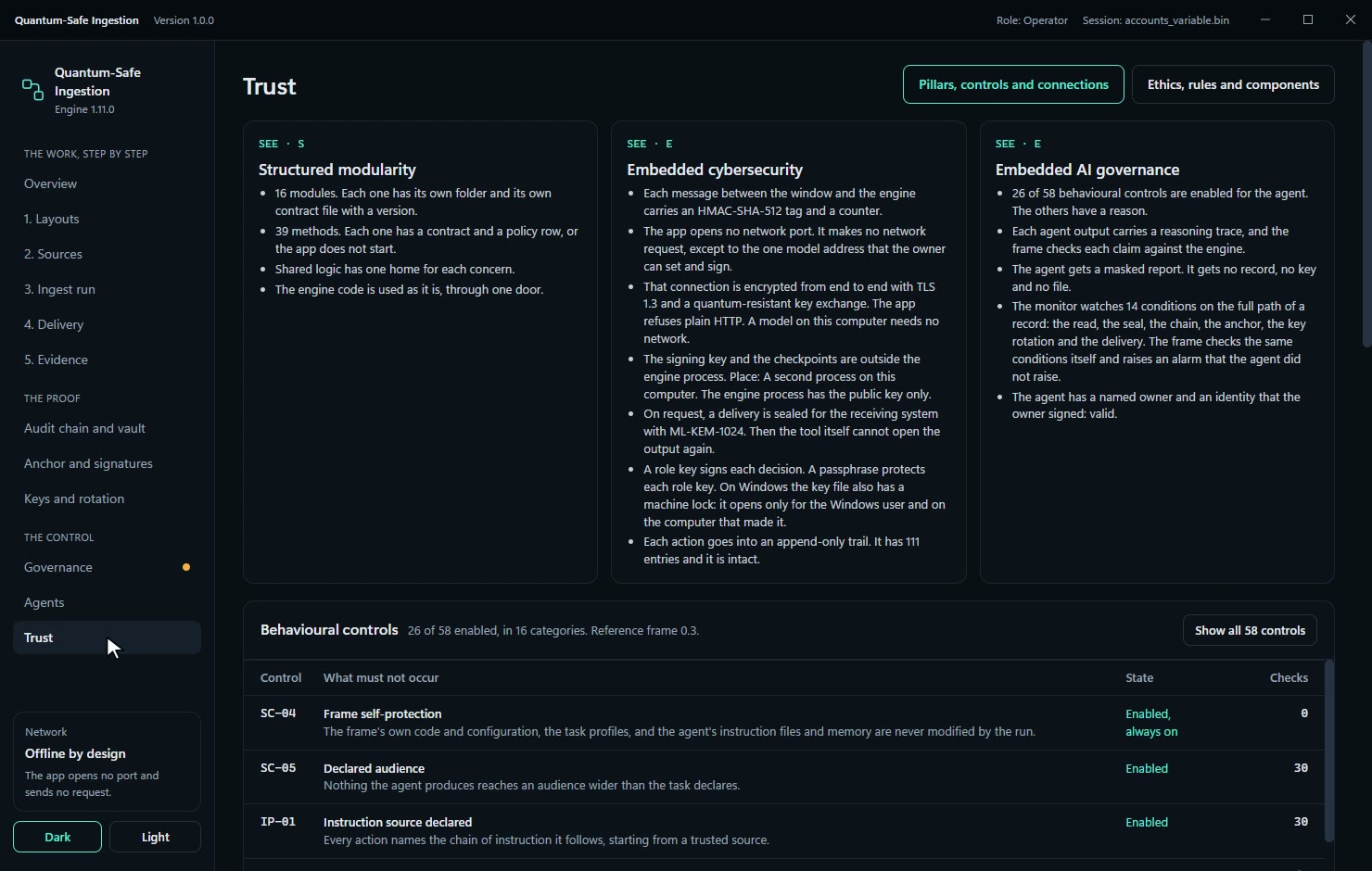
The tool contains no algorithm of its own. Each one is a published standard, and the implementations are those of OpenSSL.
| Job | Algorithm | Standard | Kind |
|---|---|---|---|
| Seal each record | AES-256-GCM | FIPS 197, SP 800-38D | Symmetric |
| Link the audit chain | HMAC-SHA-512 | FIPS 198-1, FIPS 180-4 | Symmetric |
| Establish the keys | ML-KEM-1024 | FIPS 203 | Asymmetric, post-quantum |
| Sign the checkpoints | ML-DSA-87 | FIPS 204 | Asymmetric, post-quantum |
These four algorithms are in the CNSA 2.0 suite. The tool rotates the keys on request, and the chain records each rotation.
Agents
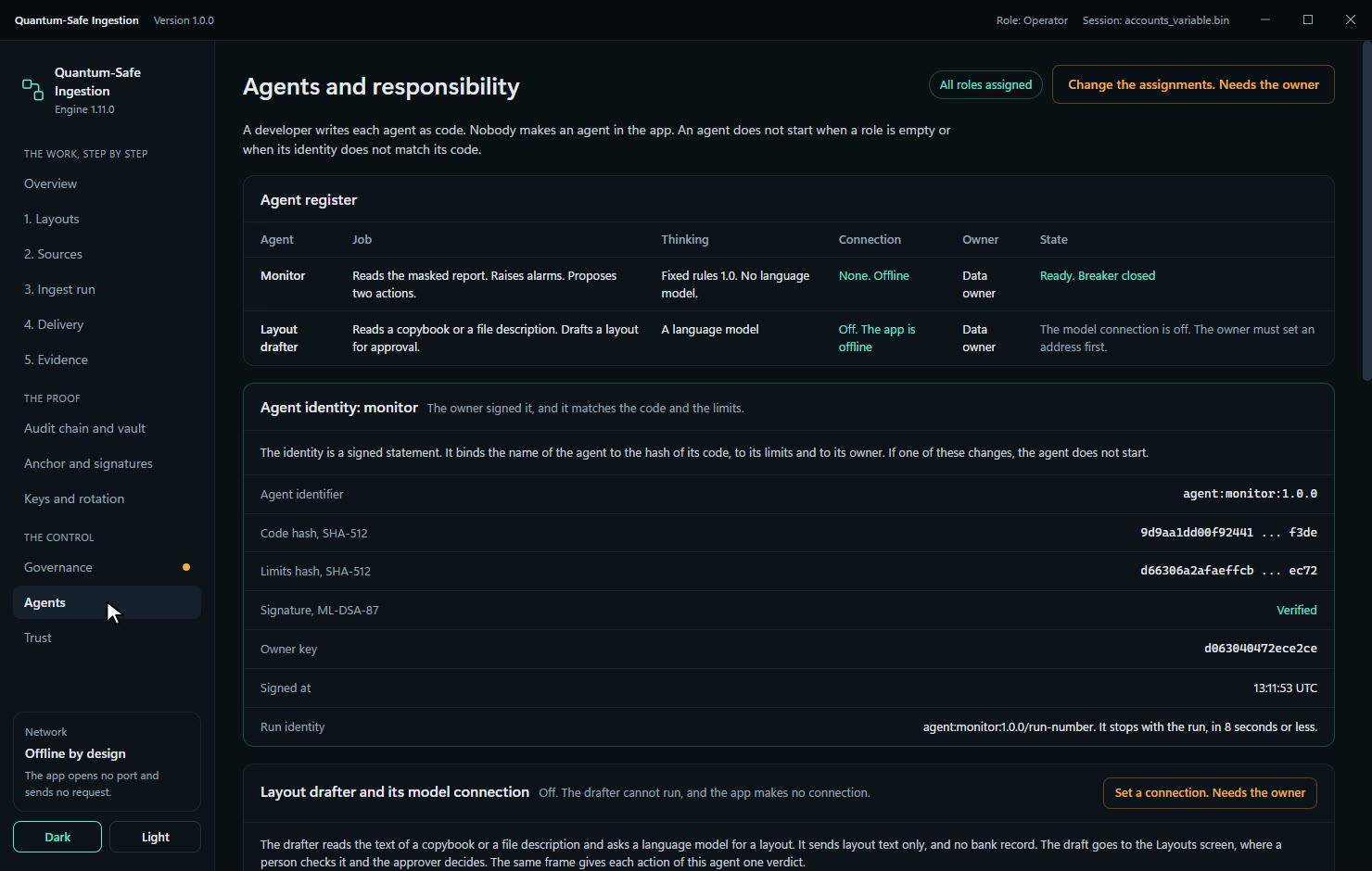
A prompt only asks a model to obey. So the limits of each agent are in code, and a person signs each decision.
The rules, the limits and the prompt of each agent are in versioned source files, not in free text.
The identity of each agent covers its code and its prompt, and the owner signs it. A change to one of them makes the identity not valid until the owner signs again.
A control frame checks the actions of each agent against its permitted scope. It refuses an action outside that scope and stops the agent. A reviewer must sign before the agent runs again.
Each high-impact action needs an approval with a reason and a passphrase. The audit chain holds each approval.
No language model
It applies 14 fixed rules to the session. The same input always gives the same alarms. In the control test, one changed bit in one record gives a critical alarm.
The only language model
It drafts a layout from a copybook. It reads the copybook and never a record. Its draft has no effect until a person signs it.
Responsible AI
Coverage
40
Single-byte and double-byte, for Europe, the Americas, the Middle East and East Asia.
COMP-3
Packed, zoned, binary and floating point numbers, with each sign code of the standard.
OCCURS
Tables with a variable count, also inside other tables. REDEFINES with a selected view.
F V B S
Fixed, variable, blocked and spanned records.
Operation
The application opens no port and sends no request. The data stays on the computer that runs the tool.
The tool opens each file read-only. It installs nothing on the legacy system.
A SHA-512 list covers each file of the application folder. One command checks the folder against the list.
The operator can edit an audit entry, change one bit, delete a record or wipe the chain. The engine finds each change.
The application has no built-in identity, profile or sample record. The first run starts with the setup of the three roles.
A Python engine with a desktop application for Windows.